Cartridge 1, 2-in-1: RO + carbon
Strip.
RO membrane and carbon filtration in one cartridge. See the published results for lead, arsenic, PFAS and more below.

Engineered on decades of water science
So audit it like one. What is already in Europe’s tap water, the peer-reviewed RO literature with PubMed IDs, and exactly what we will and will not claim.
The EU only made PFAS a limit at the tap in January 2026, and lead pipes get until 2036 to meet the lower lead limit. The rules are catching up with what is already in the system.
Sources: PAN Europe, 2024 (NGO testing); Directive (EU) 2020/2184, Annex I.
µg/l. Nord’s published test, where incoming water held these substances at many times the EU limit. Test values, not a guarantee for every source water. TFA was not part of the published test.
Peer-reviewed, mostly US EPA and WHO-linked work. Every number links to its source. None of these studies tested Osmosis One; they tested the method. Our own unit has its 16 published results.
under-sink RO units in US EPA testing kept all six PFAS below detection for the entire run. In the same test, carbon-only columns broke through after about two hours of run time.
Patterson et al., AWWA Water Science, 2019 PMID 31338490homes tested in North Carolina. Under-sink RO showed near complete PFAS removal. Typical carbon filters took out roughly 60 to 70% of long-chain PFAS.
Herkert et al., Environ. Sci. Technol. Lett., 2020 DOIrejection, mostly, across nine point-of-use RO units installed in homes in a US EPA programme. Uranium and antimony too.
Chen et al., Water Research, 2020 PMID 31958595average virus removal for RO, from a 165-article systematic review commissioned for the WHO drinking-water guidelines. Membranes overall: 5.7 log for protozoa.
Burke et al., Environ. Sci. Technol., 2025 PMID 40152626of microplastics removed at a full-scale plant, where the UF and RO line beat ozone plus carbon. No household RO study exists yet, so this is the honest ceiling.
Dalmau-Soler et al., Environ. Sci. Pollut. Res., 2021 PMID 33709311household RO units in an older study actually met the arsenic standard. The technology is not the guarantee. The unit is. That is why we publish ours.
Lin et al., 2002 PMID 12164638The CDC’s own comparison of home water treatment. Osmosis One combines two of these methods: reverse osmosis, which also removes chemicals such as lead, copper and chromium, and UV after pre-filtration.
| Method | Parasites | Bacteria | Viruses | Chemicals |
|---|---|---|---|---|
| Microfiltrationabout 0.1 micron | Removes | Somewhat | Does not remove | No |
| Ultrafiltrationabout 0.01 micron | Removes | Removes | Somewhat | No |
| Nanofiltrationabout 0.001 micron | Removes | Removes | Removes | Some |
| Reverse osmosisabout 0.0001 micronIn Osmosis One | Removes | Removes | Removes | Lead, copper, chromium and more |
| UV, after pre-filtrationlight, not a filterIn Osmosis One | Removes | Removes | Removes | No |
Removes Somewhat Does not remove. Source: CDC, About home water treatment systems (2024). Method-level guidance, not a test of Osmosis One.
Two 2-in-1 cartridges and UV-C. The first strips with an RO membrane and carbon. The second puts minerals back and polishes with carbon. UV-C protects last. All included.
Cartridge 1, 2-in-1: RO + carbon
RO membrane and carbon filtration in one cartridge. See the published results for lead, arsenic, PFAS and more below.
Cartridge 2, 2-in-1: minerals + post-carbon
Calcium, magnesium and potassium go back in after RO, and a final carbon stage polishes the taste.
UV-C, the last step
After RO and the mineral post-filter, the water passes UV-C light last. A second barrier against bacteria, viruses and parasites, working with light instead of size.
Illustrations of the processes, not technical cross-sections. Go deeper into the science.
Stored water is where bacteria come back. A classic study of 300 household RO tanks found most of them holding 10,000 to 100,000 bacteria per millilitre PMID 2611732. So the tank in Osmosis One lifts out for cleaning, and UV-C sits after everything else.
UV-C is dose-dependent. Parasites go down at very low doses; viruses need far more. We have not published a validated dose for our UV-C stage yet, so we do not put a log number on it. When we have one, it goes here.
UV dose needed, from the literature
RO water is close to empty. The WHO’s Nutrients in Drinking Water (Kozíšek, 2005) describes demineralised water as highly aggressive: it pulls minerals from whatever it touches, including food while you cook.
We add minerals for balance and taste. We do not claim a health effect from the water, and the mineral content depends on your source water and filter age.
We read the threads in r/WaterTreatment, r/Biohackers and r/PFAS. These are the objections that come up most, answered without hype. Test, don’t guess.
It is empty, not dead. RO takes minerals out along with everything else, and most of your minerals come from food anyway. We put calcium, magnesium and potassium back for taste, balance and pH, not as a supplement.
Fair. Pure permeate picks up CO₂ from the air and settles near pH 6, with nothing to buffer it. That is exactly why One Mineral Restore sits after the membrane: per Nord’s specification it brings the water to pH 7.5 to 8.5.
Often a fair hit: many are a bit of calcite with no numbers. Ours exists for taste and stability, and we are not hiding behind adjectives. The mg/l figures come from a lab, and when we have them, they go on this page.
Neither. TDS is a trend number, not a safety score. It cannot see PFAS, lead or bacteria. Use the display to spot membrane wear over time, and use a lab test for specific substances.
Osmosis One’s published ratio is 3.5 litres of filtered water per litre of concentrate. Use the concentrate for plants or cleaning. Never filter it again: it holds what the membrane rejected.
Correct, and we do not claim it. Our published results show 99.80% for lead, over 99.93% for arsenic, over 99.60% for PFOS, and 94.78% for fluoride, the lowest of the sixteen. Unit quality matters, which is why we publish ours.
They can. A study of 300 household RO tanks found most holding 10,000 to 100,000 bacteria per millilitre. Our feed tank lifts out so you can actually wash it, and UV-C is the last step before the pitcher.
Most of the time in Europe, it is. Östersund and the Veneto region were fine too, until they were not. Test first if you want certainty, and read the result against the EU limits above, not against a marketing claim.
Measures an identified system, filter and contaminant under stated conditions. Product-specific reduction claims belong here, like the 16 published results.
Covers the listed component and scope. A certified membrane does not make the complete appliance certified. .
Explores a treatment technology or a health association. It gives context, but does not certify any particular water system.
Fifteen studies behind the questions people ask about water. Open an entry for its context and limits.
15 entries
A clinical observational study of the association between plastics detected in arterial plaque and later cardiovascular outcomes.
Background research. Its findings apply to the systems, populations and conditions studied. It is not a test of Nord Osmosis One.
An investigation of micro- and nanoplastics in human tissue samples collected at different times.
Background research. Its findings apply to the systems, populations and conditions studied. It is not a test of Nord Osmosis One.
A systematic review of the occurrence of pharmaceutical residues in drinking-water research.
Background research. Its findings apply to the systems, populations and conditions studied. It is not a test of Nord Osmosis One.
Testing of selected point-of-use systems for PFAS reduction under specified conditions. Results apply to the systems tested.
Background research. Its findings apply to the systems, populations and conditions studied. It is not a test of Nord Osmosis One.
A review of PFAS removal by membrane technologies; performance varies by compound and operating conditions.
Background research. Its findings apply to the systems, populations and conditions studied. It is not a test of Nord Osmosis One.
Population research on associations between drinking-water magnesium and cardiovascular outcomes.
Background research. Its findings apply to the systems, populations and conditions studied. It is not a test of Nord Osmosis One.
Observational research comparing outcomes in regions with different drinking-water supplies.
Background research. Its findings apply to the systems, populations and conditions studied. It is not a test of Nord Osmosis One.
A short intervention study of biochemical markers. Changes in markers are not proof of disease prevention.
Background research. Its findings apply to the systems, populations and conditions studied. It is not a test of Nord Osmosis One.
A chapter in the WHO publication Nutrients in Drinking Water, discussing low-mineral water and remineralisation.
Background research. Its findings apply to the systems, populations and conditions studied. It is not a test of Nord Osmosis One.
Research on dose-response relationships. UV performance depends on delivered dose and the organism treated.
Background research. Its findings apply to the systems, populations and conditions studied. It is not a test of Nord Osmosis One.
A review of UV-C treatment methods and their use in water disinfection.
Background research. Its findings apply to the systems, populations and conditions studied. It is not a test of Nord Osmosis One.
Viral inactivation under UV treatment conditions relevant to Swedish waterworks.
Background research. Its findings apply to the systems, populations and conditions studied. It is not a test of Nord Osmosis One.
An observational study of cancer outcomes in a population exposed to contaminated drinking water.
Background research. Its findings apply to the systems, populations and conditions studied. It is not a test of Nord Osmosis One.
Population research on associations between PFAS exposure and fracture outcomes.
Background research. Its findings apply to the systems, populations and conditions studied. It is not a test of Nord Osmosis One.
Register-based research on associations between PFAS exposure and type 2 diabetes.
Background research. Its findings apply to the systems, populations and conditions studied. It is not a test of Nord Osmosis One.
Bibliography carried forward from the Nord Osmosis research library. These studies do not establish a health benefit from using Nord Osmosis One.
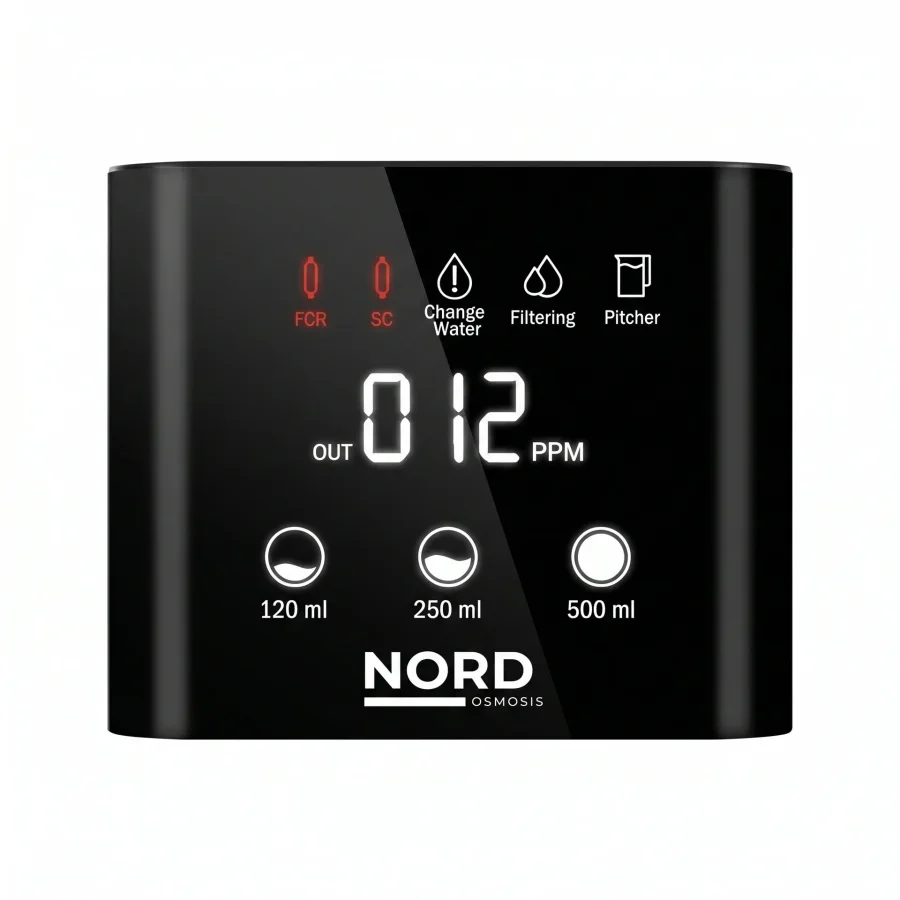
TDS estimates total dissolved solids. It can help you follow changes in your water and in membrane performance. It does not identify individual contaminants, and a low reading alone does not establish safety.
For a specific contaminant, look for a test that names the substance, the system and the conditions.
We publish the 16 results we have, line by line, instead of a headline count nobody can check.
Two published percentages did not match their own concentrations. We show the recalculated values and say so.
NSF/ANSI 58 covers the materials of the RO membrane. That is what we say, nothing more.
Research in the library gives context about water. It is not a promise about what Osmosis One does for your body.